
Function Sheets in Convention Sales: How Hotels Standardize BEO Processes and Avoid Mistakes
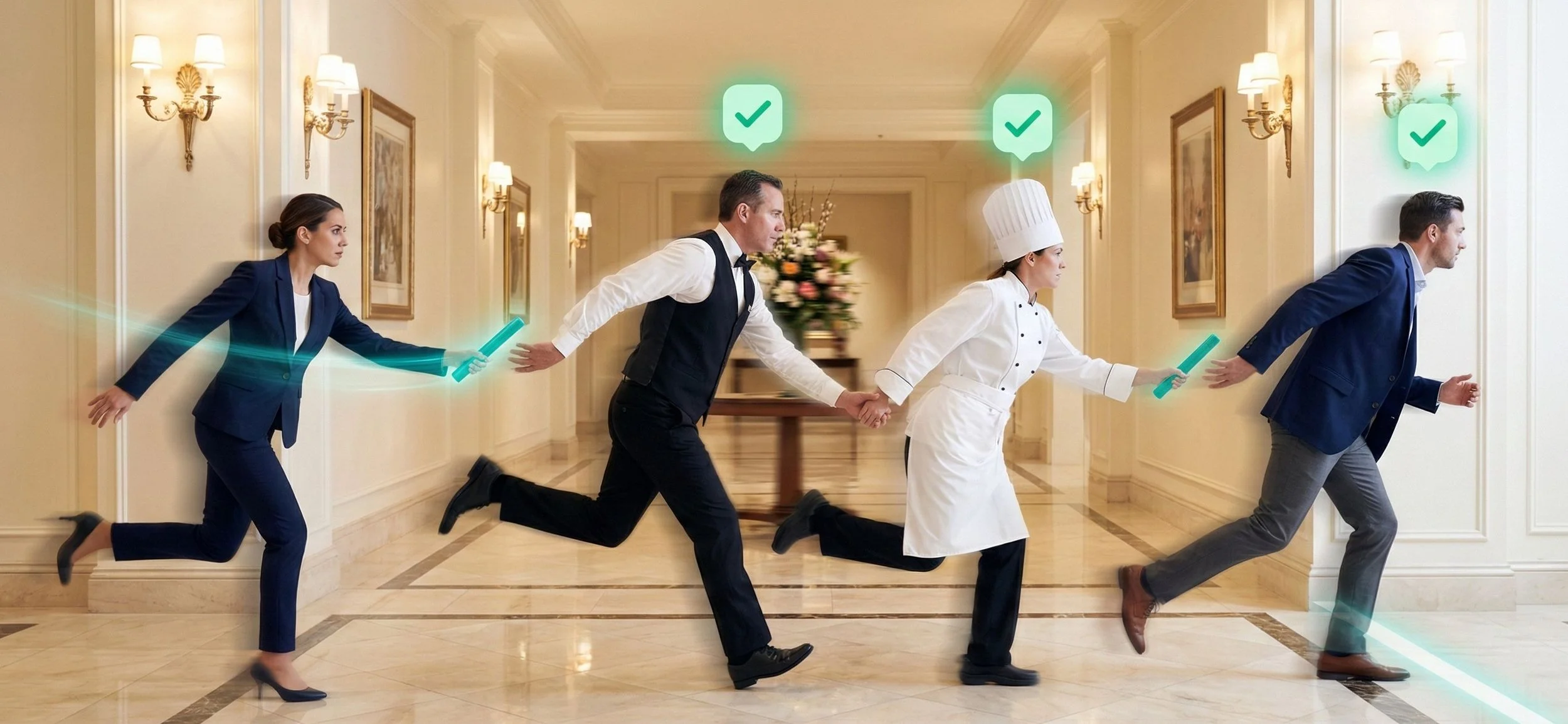
A high-quality function sheet ensures that all departments in the hotel work together smoothly. (The image is AI-generated.)
Function sheets are the operational linchpin for successful events and determine whether a hotel delivers confidently or constantly lags behind. Process optimization in the hotel industry does not begin with software, but with the question: Who is responsible for which information—and where is the only valid version?
What is a function sheet? Definition and operational significance in hotels
A function sheet—also known as a banquet event order (BEO) or event instruction—is the central operational document for every event at a hotel. It translates customer requests into specific work instructions for the kitchen, banquet, technical, and front office teams. Without clear function sheets, there is room for interpretation, which can lead to mistakes, additional costs, and dissatisfied guests.
In many hotels, the function sheet is seen as an important document, but not as a clearly defined translation of the customer's wishes into operational language. Departments pick out their information, interpret it from their perspective, and fill in the gaps with assumptions.

Janka Altmann, Director of Convention Sales, Vienna House by Wyndham Andel’s Berlin:
"Ultimately, it is always the individual who decides whether a function sheet works or not – convention sales must truly understand the customer before anything goes into the system."
Janka describes how not every customer thinks of all the necessary details and that it is the team's job to actively ask about these open issues. Her example: A meeting starts at 12:00 noon, all participants are staying at the hotel—but the rooms are not yet ready for occupancy at that time. Then someone in convention sales needs to point out that cloakroom and luggage storage are an issue, instead of just sticking to predefined checklists.
At the same time, it shows how much a clean system basis helps: her company completely redesigned its most important communication tool—the function sheet—back in 2016 and configured the PMS so that BEOs come from the system as completely as possible. When switching to OPERA, the focus was precisely on this. Today, every piece of information has its fixed place, and every operational role knows where to find the relevant information.
"We have made a conscious effort to organize our data so neatly that OPERA really supports us—it's a lot of work, but it pays off every day."
BEO versioning: How hotels avoid document chaos in convention sales
Events remain in flux: guest numbers change, additional meetings are added, program items are rescheduled. The problem arises when each of these changes results in new documents, new file names, and new attachments. Then three, four, or five versions quickly circulate in parallel within the company.
Janka clearly describes how they got this under control: In her team, all changes are always noted in the current version, and each update is given a new number. Older versions are consistently deleted. At the same time, they make sure to keep the number of updates within reasonable limits and, if possible, not to exceed a third update. This requires discipline—changes are bundled together instead of immediately releasing every small adjustment as a new round.
What's exciting is that Janka continues to work with PDFs, but not "freely flying" in emails. There is a clearly defined storage location where the current version is always located. When a BEO is updated, all relevant parties receive information about the update.
"We have exactly one place for the current BEO—anyone looking elsewhere is automatically in the wrong place."
This is a pragmatic approach that shows that not every company needs a completely new tool landscape right away, but rather consistent rules for handling its own documents first.
Error costs in the MICE business: Who pays when function sheets fail?
In operational terms, banqueting, kitchen, technical, and front office staff suffer most when there is no clear version of a function sheet. Incorrect headcounts, unclear setups, or missing information lead directly to stress, overtime, overproduction, and ad hoc firefighting measures.
At the same time, Janka's perspective hits on a point that is often overlooked: in the end, it is always the customer who pays. Internally, teams can compensate for a lot, but guests only see that rooms are not ready, food is late, or special requests are overlooked. This has a direct impact on satisfaction, reviews, and repeat bookings.
She also describes the before-and-after effect in very concrete terms: In the past, there were a lot of operational errors because different teams worked with different versions of the function sheets. Since processes, databases, and collaboration have been realigned, this problem has become manageable. An important component: cross-training, in which banquet staff spend time in convention sales and vice versa, so that both sides understand what the other actually needs.
Process optimization in the hotel industry: From manual BEO to automated control with ROCKET AI
It gets exciting when you combine this practice with modern technology. Many software solutions today help with the creation of function sheets, but remain stuck in an administrative mindset: better layout, faster export—but no real control.
ROCKET takes a different approach: convention sales automation does not start with export, but at the source. The inquiry-to-contract process has already been optimized so that quotes and contracts can be created up to 15 times faster. At the same time, the solution covers the entire area of customer communication—including changes and special requests. The "Rocket Policy Checker" automatically checks whether change requests are covered by the existing contract basis or whether additional costs and adjustments are necessary.
This exact mechanism is now being transferred to Function Sheets:
Automatic change detection: Change requests from customer communications are automatically detected, checked, and transferred to the function sheet instead of being entered manually twice.
Seamless PMS integration: Data is sent directly to the PMS or sales and catering system—no copying and pasting required.
Intelligent versioning: Employees no longer need to name and file versions ; ROCKET takes care of numbering, history, and the currently valid version in the background.
Department-specific BEOs: BEOs can be tailored to specific departments so that the kitchen, banquet, technical, and front office teams each see exactly the information they really need—based on the same source.
"We want Function Sheets to feel like they were written by a highly attentive convention sales professional who never forgets anything—only supported by AI and clean data logic."
– Evelyn Ebner, Director of Onboarding, MICE DESK
In order for ROCKET to deliver this added value, it needs exactly what Janka has demonstrated: clean, well-maintained data and logically organized items in PMS and sales & catering systems. Her setup shows how important it is to store buffet options, menus, rooms, and packages in such a way that a system can reuse them instead of starting from scratch for every event. OPERA is a very strong basis for this – provided that the possibilities are consistently exploited.
A second point shapes product development: the check-in example at 12:00 noon. Situations like this show that operational intelligence is more than just a collection of fields. Before new functions go live, targeted workshops are held with the operational teams—banquet, front office, technology—to integrate precisely these everyday scenarios into the product logic.
"We don't build features in a vacuum—we bring the kitchen, banquet, and front office to the table so that our AI can accurately reflect the reality in which it will later operate."
– Tigran Manvelyan, Chief Technology Officer and Co-Founder, MICE DESK
For years, voices such as Bernd Fritzges have emphasized that professional MICE business only works if processes in hotels are consistently professionalized and technology is used as a genuine partner rather than a fig leaf. This is precisely where ROCKET comes in: it structures the process in such a way that teams have room for what really makes a difference—namely, thinking with customers instead of chasing data.
ROI of clean function sheets: Why BEO quality has a direct impact on margins
The higher the share of group and event business in total revenue, the more directly poorly managed function sheets affect the bottom line. Every additional service that is not recorded, every forgotten flat rate, every late change that is not properly documented reduces the margin—and in the worst case, the revenue itself. At the same time, ad hoc solutions cause additional costs: more staff, more stress, emergency orders, or disposal losses.
"For me, the reliability of function sheets at every event is an economic issue—no matter how small. Anything that isn't in the BEO doesn't happen in reality and doesn't appear on the invoice."
– Janka Altmann
In their view, an incomplete BEO prevents good planning and efficient cost management, causes unnecessary additional work, and upsets customers, who then reduce their invoices or even make claims.
This is precisely where solutions such as ROCKET come into play: automated recording and checking of changes reduces the risk of services being lost. Clear, automated versioning creates transparency and protects against misunderstandings. Department-specific BEOs improve operational implementation without each department having to comb through the entire document.
For hotels with a significant MICE share, this becomes a real competitive advantage: more stable processes, fewer errors, happier teams, and a clearer margin per event— classic goals of any hotel MICE software.
5 principles for reliable function sheets:
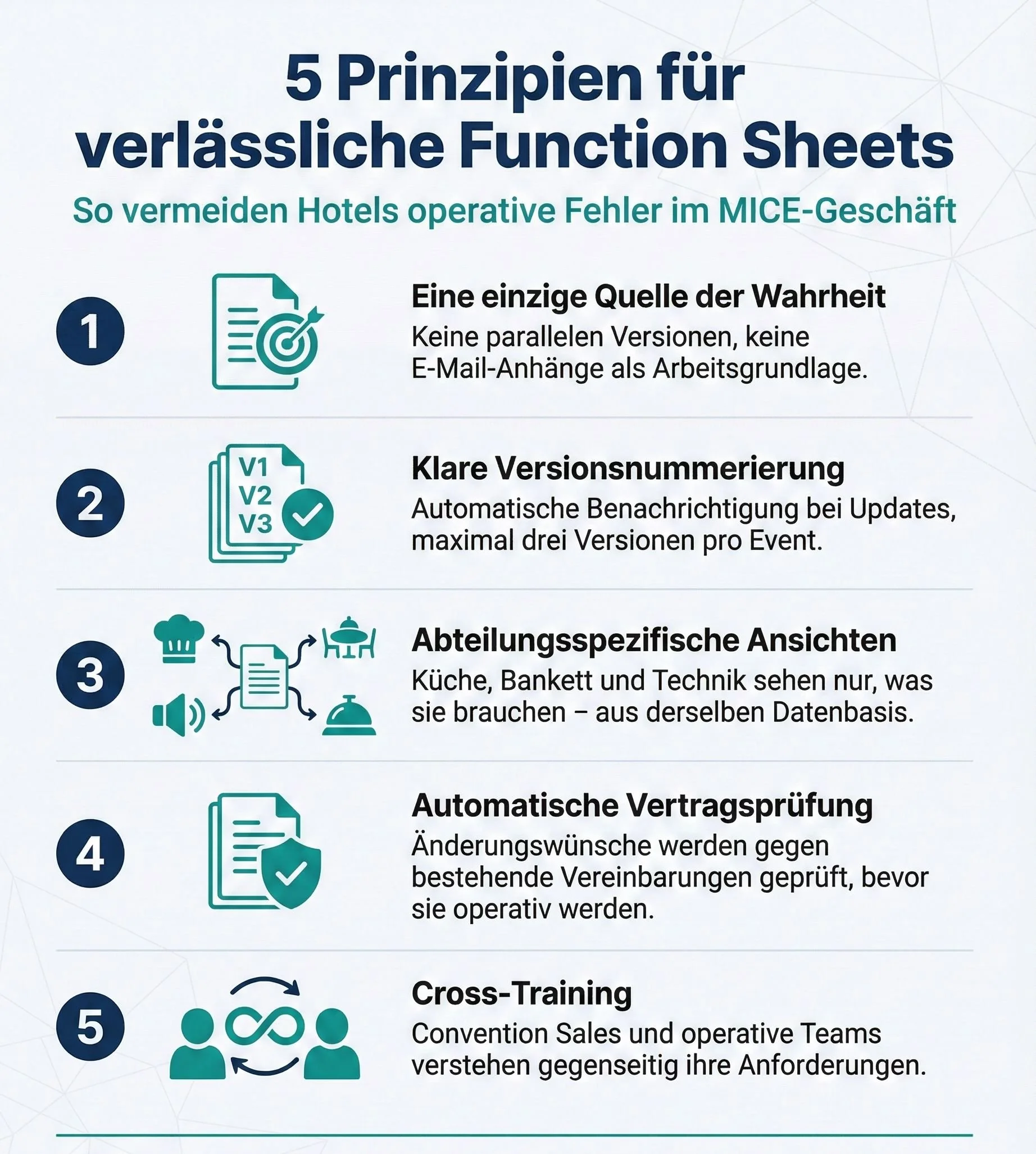
1. A single source of truth: no parallel versions, no email attachments as a basis for work.
2. Clear version numbering: Automatic notification of updates, maximum of three versions per event.
3. Department-specific views: Kitchen , banquet, and technical staff only see what they need—from the same database.
4. Automatic contract review: Change requests are reviewed against existing agreements before they become operational.
5. Cross-training: Convention sales and operational teams understand each other's requirements.
Why a ROCKET demo is worthwhile
The example of Janka Altmann impressively demonstrates how much professionalism, attention to detail, and process discipline are required to truly master function sheets, and what effect this has on error rates, teamwork, and customer experience.
ROCKET addresses precisely this issue: it dramatically accelerates the process from inquiry to contract. It makes customer communication and change management structured and controllable. It transfers the logic of clean function sheets into an automated, versioned, and department-specific controlled process.
Anyone who wants to seriously professionalize their MICE business cannot ignore this topic.
Schedule a ROCKET demo and experience live how your function sheets can become a real management tool for your convention sales—instead of a silent source of errors in the back office.